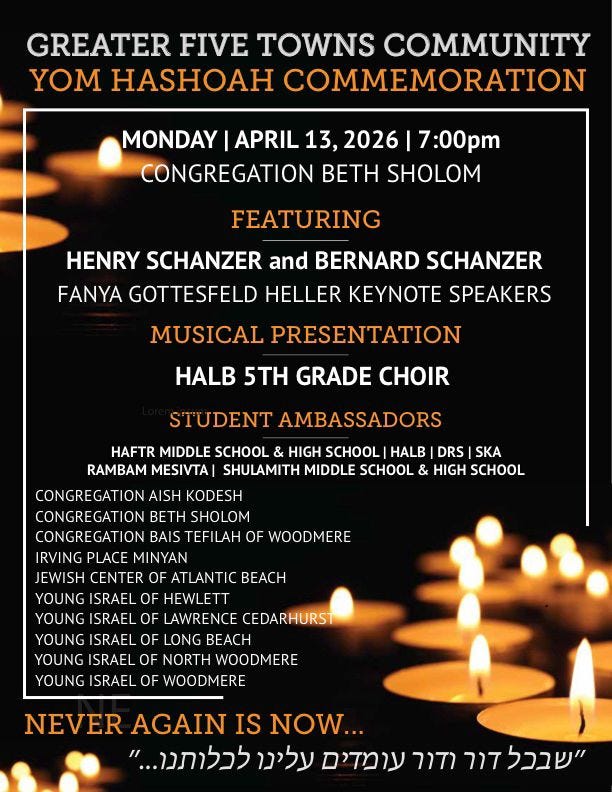
I did not grow up attending Yom HaShoah programs. When I occasionally did go, I felt justified in thinking they were just for older people who liked cantorial productions. It seemed like something rooted in a different time, for a different audience.
For years, I assumed that these programs were for those living in the shadow of the Holocaust, focused on past suffering rather than present reality.
I no longer believe that.
In recent years, I have come to understand that Yom HaShoah is not about the past. It is about the present, and perhaps even more urgently, about the future.
We are living in a time when Holocaust denial is not fading but resurging. There are voices, louder than before, attempting to erase or distort what took place. Worse than that, there are those who use the term genocide as an accusation against the world’s only Jewish State, calling it a fascist and Nazi state. The word genocide was coined because of the intentional attempt to irradicate a single nationality and now it is being misappropriately used to describe the neutralization of terrorists hiding in schools and hospitals. We are witnessing the reemergence of the very patterns that made the Holocaust possible. Hatred is no longer a distant memory. It is visible, organized, and growing.
And yet, within parts of the orthodox Jewish community, there is an absence. There is a vacuum of interest and attendance of Yom Hashoah programs.
To be fair, Yom HaShoah is a complicated day. It was established right after Pesach by secular Jews to commemorate the Warsaw Ghetto uprising. It’s placement in the month of Nissan, a time traditionally associated with joy, and it’s commemoration of fighting back are not necessarily Torah condoned values. Some Yom Hashoah programs are not structured in a way that aligns with a fully religious tone. As a result, some segments of the orthodox community have chosen to disengage from it entirely.
That decision raises a difficult question. If not now, when?
When does the orthodox community set aside time to hear the voices of survivors? When does it create a defined space to remember not only that six million Jews were murdered, but how it happened? When do we examine the conditions that allowed ordinary societies to descend into systematic hatred and genocide?
Yes, we have Tisha B’Av. But the Holocaust is absorbed into a broader narrative of Jewish suffering, without a dedicated focus on its unique horror or its living witnesses. There is no widespread practice of inviting survivors to share their testimony in that context. There is no consistent communal framework that ensures their stories are heard.
And time is running out.
We are nearing the end of the generation that can still speak in the first person. Soon, memory will no longer be carried by those who lived it, but only by those who study it. If in their living memory the deniers make noise, in the next decade and a half we can only expect the chaotic din of the uneducated haters to grow louder.
This convergence is dangerous.
The Holocaust did not take place in some distant, primitive world. It unfolded in Germany, in France, in Holland, in Poland. It occured in societies that, on the surface, were not so different from our own. The neighbors were not fundamentally different from the neighbors we know today. And yet, in a short span of time, those societies turned. Deportation and annihilation became possible in places that once appeared stable and civilized.
That is the lesson that demands our attention.
Yom HaShoah provides a framework to confront that reality directly. It creates an opportunity to hear, to reflect, and to internalize what happens when hatred is allowed to grow unchecked.
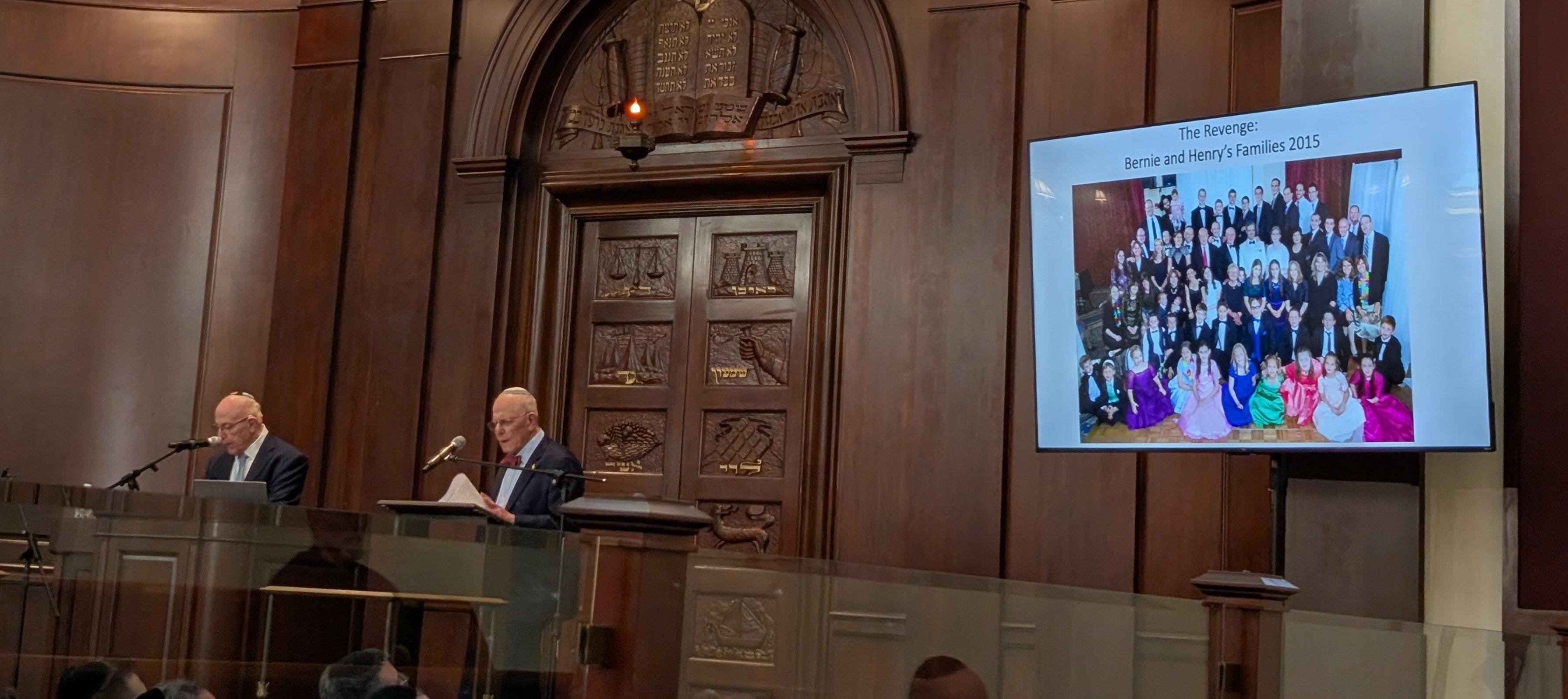
The Five Towns community program was exceptional. The stories of the Schanzer twins was extraordinary and inspirational. The program was tight and religiously appropriate. But it could not have been more than two thirds full. And yet, on that very night, in many Jewish communities, restaurants are full
That contrast is difficult to ignore.
Why is there not a greater effort to engage? Why is there not a push to shape these programs in a way that reflects the values and sensitivities of a broader religious audience, while still preserving their essential purpose? Why is the default response disengagement rather than adaptation?
These are not comfortable questions. But they are necessary ones.
Because if Yom HaShoah is set aside without an alternative, then something essential is lost. The stories are not heard. The lessons are not absorbed. The memory begins to fade.
At a time when the forces that led to the Holocaust are once again visible in the world, there is an obligation not only to remember, but to do so deliberately, communally, and with clarity. Those who attend will agree with these words. Those who never do will brush them off. But maybe there are many Jews in the middle who just never thought about this. It is to this group I appeal. Bring yourselves, bring your children and talk about the lessons.