I have always been bothered by one aspect of the festival of Sukkos. It concerns the less miraculous aspect of Sukkos.
We know that we sit the sukkah because the verse (Vayikra 23:43) explains “Lema’an yeidu doroseichem ki vasukkos hoshavti es Bnei Yisrael.” We do so that our generations will know that Hashem had the Children of Israel dwell in booths when He took them out of Egypt.
The Clouds
The Gemara in Sukkah (11b) records a debate between Rabbi Eliezer and Rabbi Akiva as to what is being commemorated on this festival. Rabbi Eliezer says they were the Ananei HaKavod, the Clouds of Glory, which surrounded and protected the nation of Israel throughout their journey in the desert. The clouds shielded them from the sun and from the desert floor. They guarded them from every kind of creature and from their enemies. When we sit in our booths, we recreate that miracle and remember that miraculous existence.
The Huts
Rabbi Akiva’s opinion is more ordinary. In fact, it can feel like a bit of a letdown. He explains that we sit in the Sukkah because the nation of Israel made actual booths for themselves. The people lived in huts in the desert, and so we live in huts to commemorate it.
I always wondered why we would make a whole 7 day festival to remember the kind of housing they had in the desert. There was nothing miraculous about it. It was not even given by God. These huts were our own constructions, our own DIY experiments in desert living. Why would we need to recreate that experience?
The American Dream
I once heard a speech by Arthur Brooks who offered a fascinating insight into the American Dream. “We descend from ambitious riffraff,” he said, “and that fact gives us pride.... Your ancestors were like the Prison Entrepreneurship guys who treated their lives like an enterprise. And that is why you get to sit in these seats today. That is the American story. “
It is the story of those who were seeking more from life in other less desirable countries who wanted opportunity for their future. As immigrants, they sacrificed everything: their context, their careers, their language, and their culture. They did it so that their children and grandchildren, meaning us, could rise and live the American dream.
Yet there is something striking about that story. It does not take long for the children and grandchildren to forget where they came from. They begin to think it all simply happened and that life is just fine. They forget the struggles and the sacrifices. They forget the three jobs their parents and grandparents worked. They forget the tenements of the Lower East Side, where three families crowded into one apartment just to make the rent. They forget the unsafe factories where people worked sixteen hours a day. Living in comfort, the next generation forgets all of it.
The Booths of Remembrance
The Rashbam explains that this is what Rabbi Akiva intended when he said we commemorate regular booths in the desert.” When the nation of Israel entered the land, they waged war and built a country. They established a government, an army, and a foothold in the land. All of this demaneds enormous sacrifice. Once it is established, however, the next generation grows used to life as it is. The generation after that assumes this is all there ever was.
So once a year, we bridge the gap between what was and what is. We go back into the huts we lived in when life was not so easy. We remember what it was like when everything required sacrifice. We step into the shoes of the ancestors who gave so much so that we could be here.
This is a profound insight. Most of the time, the older generation has no way to convey to the younger one what they sacrificed so that their children and grandchildren could be here today. They cannot fully express what they gave up so that the next generation could thrive. This is especially true of immigrant generations.
The sukkah represents the immigrant generation of the nation of Israel entering the Land of Israel. We sit protected, at ease, and in tranquility because of those who came before us. That is why it is “sukkos mamash.” On Sukkos we sit inside a very real human sacrifice, made for the sake of Heaven and for the sake of future generations.
The Pink Slips
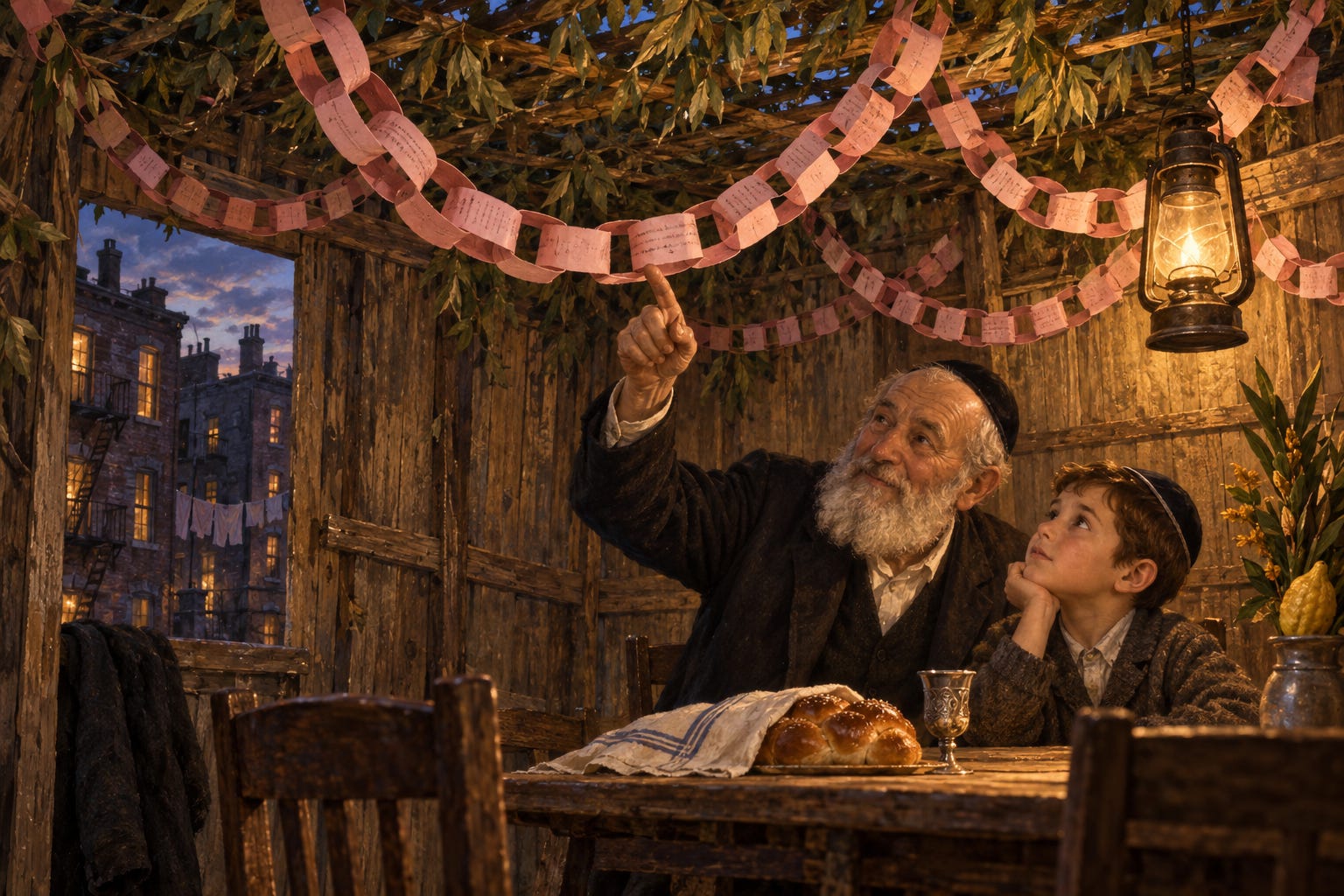
This reminds me of one particular sukkah from the 1940s in the USA. It belonged to an immigrant to America, Seymore, who was devoted to keeping Shabbos. He would take a menial job and work all week. Then on Friday afternoon he would explain that he could not come in the next morning, and he would receive a pink slip – his dismissal. The message was clear: if you are not coming in on Saturday, do not bother coming in on Monday. Almost every week, it was the same story.
Eventually he found a steady job. But he kept all those pink slips in a box under his bed. When Sukkos came, he would take them out and link them into paper chains to decorate his sukkah. That is what the sukkah truly is. It is a way of remembering those moments of sacrifice, when life was not so simple. It means returning to simple belongings and simple surroundings, to life as it was before it became what it is today.
May our sukkah be one where we, too, remember.