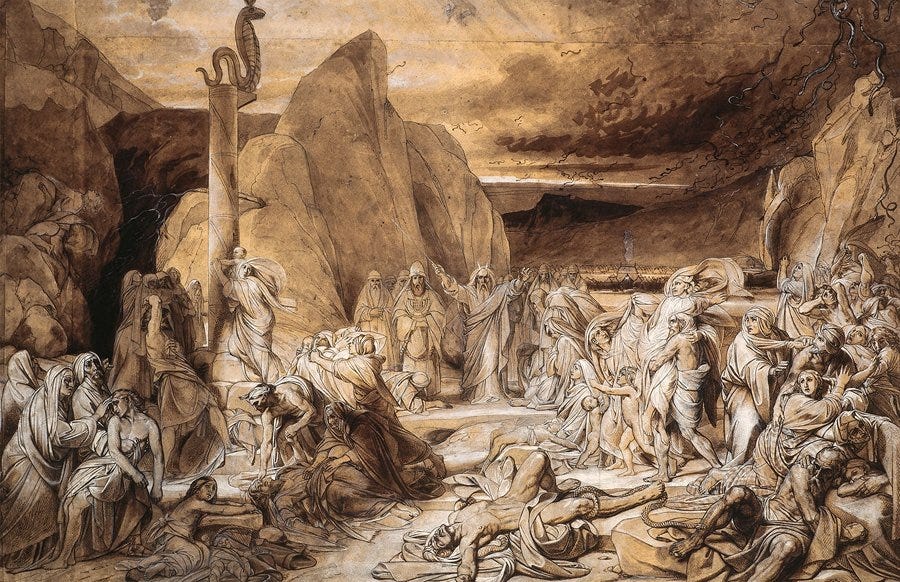
The Snakes
Near the close of the forty years in the desert, the nation of Israel found itself once again in the grip of complaint. The mannְa — the miraculous bread that had sustained them daily — now drew their frustration. It was dry, insufficient, monotonous. They cried out to God, and God’s response was swift: fiery serpents descended upon the camp, biting the people, and many died.
Moshe Rabeinu interceded, and God instructed him to fashion a copper serpent and mount it upon a pole. Whoever had been bitten could look upon it and live. The episode is familiar. But a single grammatical detail, hiding beneath the surface of the text, transforms our entire understanding of what occurred.
The expected word for God’s action would be va-yishlach — God sent the serpents. But the Torah instead uses va-yeshalach — a different conjugation entirely, one that carries the meaning of releasing.
How they came
Rav Samson Raphael Hirsch draws out the full weight of this distinction. For forty years, the nation of Israel had lived inside a Divine bubble. The Clouds of Glory sheltered them from the desert sun and enemy eyes. Water flowed miraculously from a rock that traveled with them. Food descended from heaven each morning. Every dimension of physical life was orchestrated by Heaven.
And yet, there came a moment when the people said: this is too much. The intensity of Divine proximity felt overwhelming, suffocating. They wanted relief from the weight of living so explicitly inside God’s embrace.
God’s response was not punitive in the conventional sense. It was, in a way, accommodating. You wish to step outside the bubble? Then I will release you into the world as it actually is. And where did that release deposit them? In the middle of the desert. And what lives in the desert? Serpents.
God did not send the serpents. He released them — withdrew His protection and allowed the natural world to reassert itself. The serpents were always there. What had held them back was the invisible shield of divine presence.
Yossel the Holy Miser
There is a famous Chassidic story about a man named Yossel who lived on the outskirts of a small town. He was widely regarded as the village miser: wealthy, but notoriously closed-fisted. When the poor came to his door, he would receive them warmly, listen patiently to their needs — and then turn them away. The community had long since given up on him as a source of charity.
When Yossel lay on his deathbed, the head of the chevra kadisha came to him with a final opportunity: contribute to the communal burial fund, and we will ensure you receive a proper burial. Yossel refused even this. The head of the chevra kadisha, deeply offended, declared that the community would not attend to his burial.
Yossel died. His body remained unclaimed for a day, then two days. Finally, one compassionate soul in the community could bear it no longer. He gathered the body, performed the purification rites, and arranged a quiet, unassuming burial.
That same week, on Thursday evening, the town Rabbi began receiving an unusual stream of visitors. One after another, families and individuals came to his door — a struggling father who couldn’t make ends meet for Shabbos, a widow raising young children, working people whose weekly earnings simply fell short of their needs. After the fifth such visitor, the rabbi stopped and asked: is there something different about this week?
The man at his door looked puzzled. Usually, he said, there was an unmarked envelope that appears under my door every Thursday. It contains exactly the amount I need to bridge the gap between my earnings and what Shabbos requires. This week — it wasn’t there.
The rabbi was seized by a sudden, terrible understanding. The truth assembled itself: Yossel — the miser, the man who had turned away every beggar — had been quietly sustaining the poor of the entire town for years. The unmarked envelopes. The anonymous provision. The patient listening that was never indifference but was, in fact, a cover for his hidden generosity.
The rabbi sought forgiveness publicly, arranged an honorable burial, and asked that he himself one day be laid to rest beside Yossel.
We are the Recipients
The power of this parable lies in what it reveals about our own spiritual condition. Most of us, most of the time, are receiving the envelope.
The energy we have when we wake each morning. Our health. Our children. Our sustenance. The air we breathe. These are not background noise — they are an unbroken stream of divine provision, arriving quietly, consistently, week after week, in ways we have long since stopped noticing.
And then one week, the envelope doesn’t come. A diagnosis. A loss. A reversal. And suddenly we look upward: God, what happened? How could this be? But the question we rarely ask is: where was our gaze all the weeks the envelope did arrive?
This is the message of the parsha. God will be present in our lives to the degree we make room for Him. When we push Him to the margins — when the constant miracle of existence becomes white noise — He does not send affliction. He simply releases us into the world as it is, without the invisible buffer of His protection. And we discover, quickly and painfully, how much that buffer was doing.
Where Is God?
The Kotzker Rebbe[6] was once asked by a young student: where is the Almighty? Where is God to be found?
He answered: God is like sunlight. He is wherever you let Him in.
The serpents in the desert were not an act of divine anger. They were a mirror — a revelation of the world that exists when we close the window. The envelope that arrives each week unnoticed is the same revelation, running in reverse. May we learn to notice the light before we find ourselves standing in the dark.
Picture Credit:
The Copper Serpent. By Russian artist, Fyodor Bruni, 1839, Tretyakov Gallery)