Menachem Av is a month of consolation. The very name – Menachem, to comfort – sets the tone for what this period demands of us. But who or what exactly are we consoling?
One of the most striking and underappreciated answers lies in the nature of the destruction itself – not merely the physical destruction of the Beit HaMikdash, but the destruction of something far more intimate: our language.
Rabbi Shmuel Shmelke HaLevi Horowitz of Nikolsburg (1726–1778), Chief Rabbi of Sieniawa (Shinive), offers a fascinating insight. The name of the month already contains the answer: Menachem Av – consoling the Aleph Bet, the letters of the Hebrew alphabet. The object of consolation are the letters themselves (Sefer Ramataim Zofim). But why should the letters of the alphabet need consoling?
The Talmud addresses this directly. Rabbi Yochanan teaches that since the Jewish people sinned through the misuse of the Hebrew alphabet, they were punished through it as well (Sanhedrin 104a). When we examine Megillat Eicha, the central text of Tisha B’Av, we notice something unusual about its structure. Nearly the entire Megillah is written as an acrostic – each verse following the order of the Aleph Bet, from Aleph to Tav, letter by letter, in exact sequence.
The destruction, in other words, was linguistic at its core. The corruption of how we spoke, how we expressed ourselves, how we related to one another through words – this was among the root causes of the calamity. The Megillah memorializes that destruction by moving through the entire alphabet, as if to say: every letter mourns; every one of the twenty-two building blocks of language has been affected.
This is why the period of Bein HaMetzarim, the Three Weeks, is exactly twenty-two days long, corresponding to the same twenty-two letters that were corrupted (Pri Tzadik, Matot 10).
This carries an urgent message for us today. If the destruction was rooted in the misuse of language, then the consolation, the nechama, must also begin with language. The path toward redemption runs through the way we speak.
What does this look like in practice?
In Kabbalistic thought, there are two modalities of consciousness: mochin de-gadlut, expanded consciousness – and mochin de-katnut, contracted consciousness. As the Jewish people entered exile, one of the great losses was the contraction of our national consciousness. In simple terms, we lost the ability to think big. Our conversations and concerns shrank from the national to the granular, from the visionary to the petty.
Almost all complaints emerge from mochin de-katnut – small thinking. We complain that the temperature is uncomfortable, without registering that others welcome it. We fume at traffic, without acknowledging that the cars around us carry people with equally legitimate destinations. We sigh when rain ruins a family outing, without pausing to recognize that the same rain sustains the crops that feed us. We grumble that the speech ran long, without considering that others wished it were longer.
All stress and distress emerge from being trapped in the here and now, unable to lift our gaze to something larger. And this smallness is not merely a personal failing – it is a spiritual one. It is a continuation of the very corruption that the Megillah mourns.
The path toward redemption must therefore begin with how we speak. Language is not incidental to who we are – it is constitutive of it. The Hebrew word davar means both “word” and “thing.” In the Jewish worldview, words do not merely describe reality – they create it. When we speak with smallness, we create smallness. When we speak with vision, with gratitude, with expansiveness, we begin to build something real.
This Tisha B’Av, let us take seriously the idea that nechama begins in our mouths. Let us step out of the narrow corridors of complaint and pettiness and speak like people on the cusp of redemption – using language to elevate, to connect, to envision a world that is healed.
May this Menachem Av be a month in which we console the Aleph Bet – restoring dignity to every letter, every word, every conversation. And may that restoration be the first quiet step toward a redemption that is, please G-d, very close.
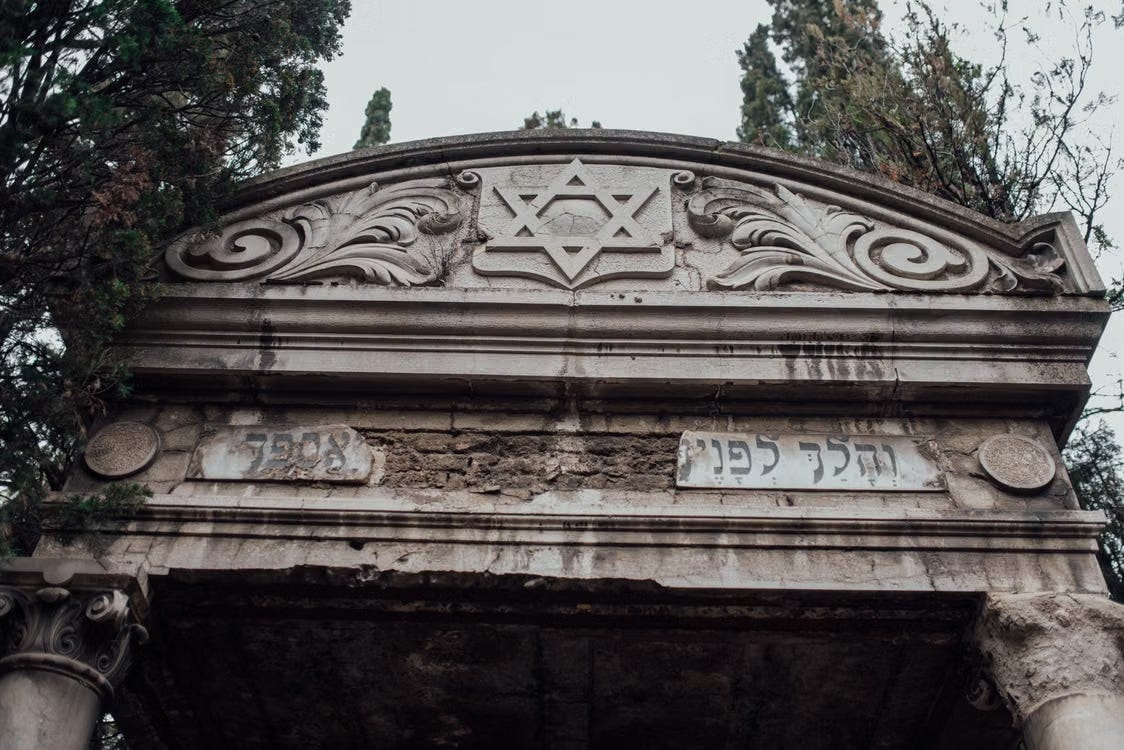
Photo by Arina Krasnikova from Pexels: https://www.pexels.com/photo/tympanum-over-entrance-to-crypt-in-cemetery-6907852/